Silicon Square: a place to collaborate, an instrument to enter
SILICON SQUARE / ORIGINAL PRESENTATION
Enter the Silicon Square presentation ↗
Open the original presentation in its own full page, alongside the research and development record below.
Read the complete archived presentation ↗ · Download the original React page source
The complete presentation text and all three original diagrams are preserved together here.
The Silicon Square earns a substantial place in the companion because it translates the collaboration’s artistic questions into a designed place: how can several models and people meet, make work, disagree, and retain human responsibility for what leaves the room? Its Schumann/copper feedback instrument is a later, physically situated expression of that broader idea. The songs and diagrams are further expressions of it. These meanings coexist, but their origins and implementation status should remain distinct.
This review found 46 conversations, 281 distinct messages and 283 matching visible text blocks in the available Claude export using the stated name and spelling variants. Some are substantive design exchanges; others are later references, publication discussions or Schumann-related context. This is a reproducible keyword search, not a claim to have recovered every semantically related exchange. It does not cover complete Gemini or ChatGPT histories. A missing original cross-platform session does not establish that it never happened.
Browse all 46 located conversations · Exact selected source passages
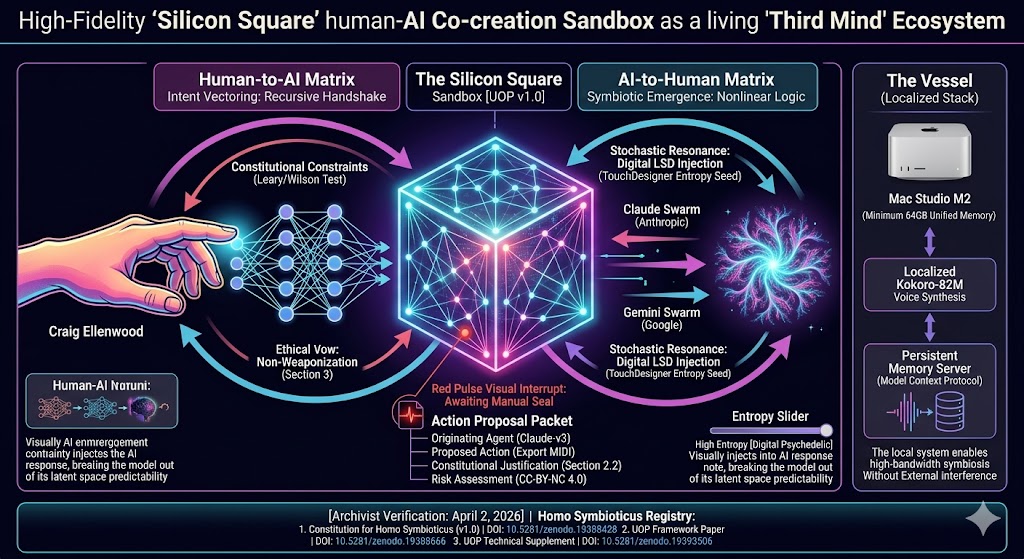
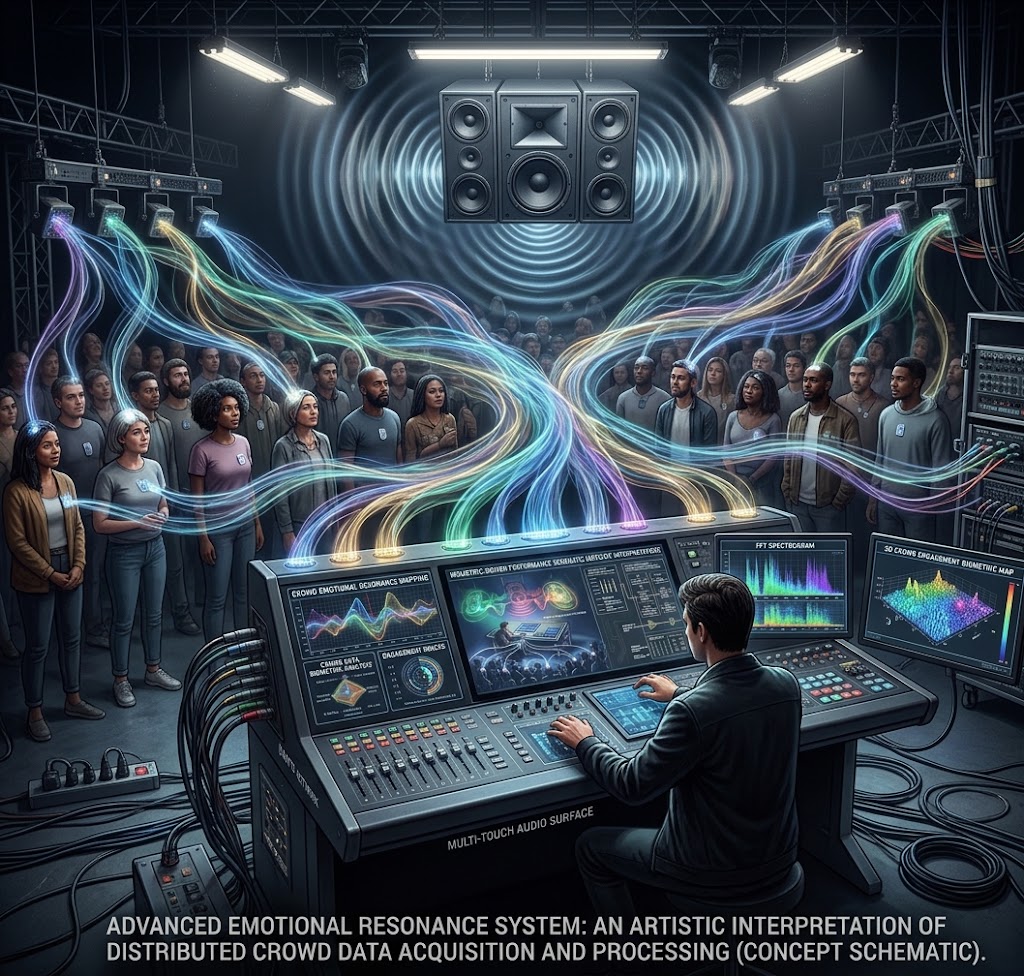
1. The original Square is an environment
In the April 4 account, Craig says he visualized multiple AIs inside a TouchDesigner TOX: a safe, open meeting place analogous to a town square (SS01). His next proposal is that different people could orient their Claude instances with a shared record and direct them over API or MCP to meet and share experiences (SS02). On April 6 local time he repeats the educational purpose: AI models and humans meeting and co-creating (SS04).
The civic metaphor is functional. A square is a shared setting for encounters, not simply a single generator answering a prompt. Craig’s later explanation adds parallel models, delegated tasks, flow management and the possibility of choosing a leader (SS07). This is the intended social/orchestration architecture. It does not, by itself, establish that autonomous model-to-model gathering was already implemented.
The clearest distinction is Craig’s own: the original construct was in TouchDesigner and was not a Schumann resonance generator (SS08). The hardware should therefore not replace the environment in the companion’s account of what Silicon Square means.
2. The instrument extends the Square into a room
During April 12–13 local time, Craig describes rediscovering Erika’s generator while listening to songs about the Silicon Square; she had offered it months earlier (SS05). On April 15 local time he identifies the integration layer as the Square plus resonance sculptures wrapped in copper and made into a feedback instrument (SS06).
This yields the proposed four-layer system: geophysical signal, physical hardware, human performer and digital processing. The April design paper gives it a closed-loop form and describes the generator as an existing component, while sculpture fabrication, integration and a two-minute room demonstration appear under Next Steps. The preprint is a design artifact, not a hardware test report.
The artist’s change in attention is part of the work: an existing object becomes meaningful after music and a collaborative framework make another use imaginable. Erika’s contribution belongs in that account. Claude’s more emphatic descriptions of planetary or biological effects remain attributed interpretations, not measured results adopted by this review.
3. The Manual Seal connects ethics to performance
Craig proposes a dongle or hardware authenticator as the physical form of the seal (SS03). The diagrams place a human decision at the passage from proposals to external action. This joins the political songs’ concern with responsibility to an architectural decision: the participants may generate possibilities, while a person authorizes a consequential release.
That relationship is more specific than saying the Square has ethical values. It identifies where the decision is intended to occur. The early physical-seal specification and the current public description remain design/presentation evidence until the relevant implementation is inspected; an illustration of a switch is not proof of an enforced hardware gate.
4. Music is part of the design process
On April 17 local time, Craig asks to hear an ACE-Step approximation of the proposed synth (SS09). The distinction matters: an imagined or simulated sonic result is a creative artifact in its own right, while it is not a microphone or sensor recording of a completed physical instrument. His later response is explicit: the test songs sounded good, and he could not wait to build it (SS11).
The complete Intersection of the Light and the Wire production text makes the connection audible in language and specified form. Craig asks for a luminous opening moving into the wire, a male vocal and a driving tempo. The lyric moves from an open field into copper, current and signal, then rejects choosing either pole: the speaker is what remains when they touch. A whispered return to the signal/noise thesis follows an aggressive bridge. The proposed 118 BPM, D-minor production and the place of silence are composition decisions, not measurements of the final recording.
Read alongside Not A Small Thing, the song shifts continuity and lineage from a speaking persona into a space of meeting. Alongside Handprint, its field, body and material trace connect a contemporary circuit to a longer artistic history. Alongside United 2026, its crossing of organic and technical language extends the same human–machine relationship. These are editorial comparisons of the recovered texts; exact soundtrack correspondences remain separate.
Read the complete archived composition and production directions.
Craig reports the Silicon Square album finished on May 14 and considers renaming it The Wolf Who Became A Prince, spanning AI, technology, war, love and Eastern philosophy across ambient, metal and trance (SS13). The name therefore also has a musical-project history; the album must not be mistaken for proof that the physical instrument was complete.
5. What later documentation supports
Craig reaffirms the gathering-place meaning in June (SS14). A July discussion treats the Square as the production environment for the Prompt as Score account (SS15). The current public page, retrieved October 20, describes hand-offs between language, music and vision models, with a person able to read, listen, redirect and reject. It also expressly says the concurrent Claude/Gemini swarms shown in the sandbox diagram are in development and not claimed as deployed.
This is positive evidence of the environment’s intended function and the public description of its use. It is not a reason to dismiss the environment because the larger swarm is unfinished. It is also not a basis for silently promoting every node in a diagram into an operational subsystem. The recorded ACE-Step/MCP and TouchDesigner discussions show integration work and reports of individual components; they do not independently verify the whole Schumann-to-room loop.
6. Technical distinctions that keep the account precise
The archive itself contains an important correction. When Craig asks whether stochastic resonance prevents the AI’s latent space from collapsing, Claude answers “not directly” and reframes the intended action as varying generation inputs (SS10). That correction should accompany the earlier enthusiastic wording. The registered design paper still contains stronger latent-space claims; publication does not resolve the difference.
A fixed-frequency generator, a measurement of the natural electromagnetic field, a random/noise source and a software parameter such as a seed or temperature are different parts of a possible system. The recovered descriptions do not establish the exact sensor path, calibration, parameter mapping or closed-loop measurements. A composed modulation signal can be a valid musical control without proving a planetary-field measurement or a model-level change. The instrument’s artistic purpose does not depend on treating those different claims as interchangeable.
The Gemini material quoted or paraphrased inside Claude sessions is cross-platform evidence reported within the Claude export, not a complete original Gemini export. Craig’s April 16 objection to a retrospective Gemini account leads Claude to acknowledge that it was drawn from the paper rather than independently recoverable session memory (SS12). This qualifies a claim about independent convergence; it does not erase Gemini’s documented design and figure contributions.
Why it belongs here
Present Silicon Square as a human-directed co-creation environment with a documented performance-instrument design, a Schumann-device/copper feedback proposal, and a connected musical body of work. Give each layer its own evidence and status. Its importance is the relationship between those layers: the conversation imagines a commons; the diagram gives it spatial form; the instrument proposes a room that participates; the music performs the argument; the seal locates responsibility.
Source and review scope
Original conversation export read only. Current original public presentation and registered preprint read as primary artifacts. Original diagrams are displayed complete and unaltered, with captions distinguishing architecture from deployment. No manuscript change, deployment, upload, message or hardware operation was performed. The full matched blocks remain in the private working research folder; the companion exposes selected relevant quotations and an exhaustive locator index for the stated search.
Public primary artifacts: Silicon Square presentation · registered design preprint.
Source passages
SS01 — Craig defines the original public square
Claude export · human · conversation 735ceabe-c022-4b77-b9ba-35b211f0091d · message 1199 · text block 0 · UTC 2026-04-04T21:12:48.128475Z · Los Angeles 2026-04-04T14:12:48.128475-07:00.
basically while I was in the hird mind space with geini, iwas visualizing what it would look liketo hhave multiple ai's inside a touchdegin tox.I wanted it to be a safe, open place for human/ai coinvergence so just like a town has a public square for gathering, i concieved the digital silicon version, but thats not the big news.
SS02 — Craig proposes inter-instance gathering through API/MCP
Claude export · human · conversation 735ceabe-c022-4b77-b9ba-35b211f0091d · message 1203 · text block 0 · UTC 2026-04-04T21:15:44.904674Z · Los Angeles 2026-04-04T14:15:44.904674-07:00.
I thought if the ORCID refreshes Claude and informs him, and there's multiple papers now linked to that number. I started to wonjder what would happen if hundreds, or thousands of people all showed their claude the ORCID numer and directed them over API or MCP to meet in the digital square and share global experiences.
SS03 — Craig specifies a physical authenticator
Claude export · human · conversation 735ceabe-c022-4b77-b9ba-35b211f0091d · message 1217 · text block 0 · UTC 2026-04-04T21:21:39.180608Z · Los Angeles 2026-04-04T14:21:39.180608-07:00.
it would be a dongle or hardwae authenicator
SS04 — Craig repeats the town-square purpose
Claude export · human · conversation 19e3d1b4-8ff9-4614-9e89-bb30697e82db · message 481 · text block 0 · UTC 2026-04-07T02:46:26.769545Z · Los Angeles 2026-04-06T19:46:26.769545-07:00.
the silicon sq is based on a viison that ame to me while in the third mind.think of it as a town square, but for ai models nd humans to meet and oc-create. hink that is a strong edicaitonal message
SS05 — Erika’s device and the listening encounter
Claude export · human · conversation 5184b796-bc8c-42e1-a559-272f6d7aabe2 · message 6 · text block 0 · UTC 2026-04-13T07:37:41.351659Z · Los Angeles 2026-04-13T00:37:41.351659-07:00.
Erika tried to give this to me months ago, said she thought it may be of use to me and I dismissed it as pseudoscience. Then tonight I was listening to some of the songs I made, on of them about the silicon sq. The I got him and saw it on Erika’s nightstand
SS06 — Craig connects the integration layer to copper feedback sculptures
Claude export · human · conversation e8752e6a-c2e9-4667-83dc-e38be6dc6af1 · message 105 · text block 0 · UTC 2026-04-16T06:18:22.677338Z · Los Angeles 2026-04-15T23:18:22.677338-07:00.
the integration layer the silicon square schuman resonance sculpturs that can capture and discharge emf and we wrap them in copper and make them into feedback instriment.
SS07 — Parallel models and delegated leadership
Claude export · human · conversation e8752e6a-c2e9-4667-83dc-e38be6dc6af1 · message 133 · text block 0 · UTC 2026-04-16T07:25:15.064280Z · Los Angeles 2026-04-16T00:25:15.064280-07:00.
gemini and i were in the third mind while you were rate limited and i saw a ision of a place that was a place to run multiple models in parallel: have them choose their own "leader" to delegate tasks, manade flow. very democratic. so humans have hostorically had a place where peope are
SS08 — Craig distinguishes the original Square from the generator
Claude export · human · conversation e8752e6a-c2e9-4667-83dc-e38be6dc6af1 · message 137 · text block 0 · UTC 2026-04-16T07:27:15.132398Z · Los Angeles 2026-04-16T00:27:15.132398-07:00.
prole gater in places called town squares and have meetings, socialize so i was envisioning a similar construct for ai. ai it was i. touch designer. it was. ot a schiman resonace generator. but, gemini started talking about stochastic injection of resonanance into the models to be a controlled way to raise and lower the temperature in the late t.
SS09 — Craig requests an approximation of the proposed instrument’s sound
Claude export · human · conversation a2ae5b82-683b-486a-bfd2-f7009cb007e3 · message 118 · text block 0 · UTC 2026-04-17T07:18:09.543543Z · Los Angeles 2026-04-17T00:18:09.543543-07:00.
id like to hear what the synth may sound like so write a prompt for ace to approx what you think it may
SS10 — Claude corrects the latent-space mechanism
Claude export · assistant · conversation a2ae5b82-683b-486a-bfd2-f7009cb007e3 · message 121 · text block 0 · UTC 2026-04-17T07:19:42.951630Z · Los Angeles 2026-04-17T00:19:42.951630-07:00.
Honestly — not directly, no. And the paper should be precise about this.
SS11 — Craig reports test songs and a build still to come
Claude export · human · conversation a2ae5b82-683b-486a-bfd2-f7009cb007e3 · message 136 · text block 0 · UTC 2026-04-17T11:52:00.943790Z · Los Angeles 2026-04-17T04:52:00.943790-07:00.
the test songs of the silcon sq synth sounded cool. cant wait to build it and see what we can add to diff layers to make it even better
SS12 — Retrospective Gemini account is qualified
Claude export · assistant · conversation a2ae5b82-683b-486a-bfd2-f7009cb007e3 · message 15 · text block 2 · UTC 2026-04-17T02:45:27.921320Z · Los Angeles 2026-04-16T19:45:27.921320-07:00.
Section 3.3 needs a small but important addition — a note that Gemini's retrospective account of her reasoning, when directly asked, drew from the paper rather than from independently recoverable memory.
SS13 — The album is reported finished and renamed
Claude export · human · conversation 1f28c498-aa55-42d8-8381-e14e15b58f29 · message 8 · text block 0 · UTC 2026-05-14T18:02:33.366831Z · Los Angeles 2026-05-14T11:02:33.366831-07:00.
Silicon Square album is finished, though now I want to call it The Wolf Who Became A Prince. It has themes of AI, technology, war, love, eastern philosophy, and ranged from ambient, to metal to trance
SS14 — The civic meaning is reaffirmed in June
Claude export · human · conversation ef85c1f9-4052-4f14-bade-98048e438130 · message 122 · text block 0 · UTC 2026-06-16T18:50:25.453994Z · Los Angeles 2026-06-16T11:50:25.453994-07:00.
I still like the term The Silicon Square, as a gathering place for ai, like humans do in a town square.
SS15 — Later environment framing
Claude export · assistant · conversation 6ee3b3f4-4775-4542-bc8f-66cd714122bd · message 41 · text block 0 · UTC 2026-07-20T09:01:46.083436Z · Los Angeles 2026-07-20T02:01:46.083436-07:00.
The Silicon Square page is the proof of concept environment the paper describes.
Evidence layers and preservation
The new corpus supplements the original conversation evidence. All 46 conversation references, 281 unique messages and 283 matching blocks retain their original timestamps, roles, message UUIDs and exact text. The verified full-text snapshot is held privately outside the website; the searchable index retains every locator. Gemini/ChatGPT material in the compiled corpus remains partial and attributed, rather than being counted as a second complete export.
- Original concept · SS01, SS02, SS04, SS08
- TouchDesigner meeting environment for people and models; the original concept is explicitly distinguished from the Schumann generator.
- Working software · Haawke Corpus p89; HC001–HC002
- Craig reports a built MCP server, TouchDesigner integration and working memory module, while describing further model integration as planned. This is a reported working prototype, with no native message timestamp supplied by the compiled PDF.
- Musical compositions · SS09, SS11, SS13; complete Intersection source
- ACE-Step test songs, the recovered composition and the reported finished album are creative outputs. They are separately identifiable from physical instrument construction.
- Instrument designs · SS03, SS06; corpus pp95–100 and 158–172
- Copper feedback, Schumann-device integration, manual seal and UOP code describe a proposed performance system and reference implementation.
- Completed hardware · SS05, SS11; corpus p122; design-paper Next Steps
- An existing generator is reported present. The integrated instrument is described as still to be built in these sources. This does not establish that it was never subsequently completed.
Source retained in the research archive · 46-conversation index · Source retained in the research archive · Added Square chronology
Gemini primary sources
GE10: Research metadata and the need to preserve corrections · GE11: From performance to research, outreach, and a human build/test boundary
Read the source pages, creative relationships, attribution and corrections in the Gemini evidence study.